The format
Son et lumière: from a French château to the Giza plateau
Where the sound and light show comes from, how the form works and what a 1961 date at Giza does and does not tell you about tonight's show.
Choose my night ↗Quick answer
Son et lumière is a nighttime entertainment that pairs lighting with recorded narration and music, usually outdoors at a place of historic importance. Wikipedia credits the idea to Paul Robert-Houdin, curator of the Château de Chambord, where the first show ran in 1952, and says the first African production was staged at the Pyramids of Giza in 1961.
Sound and light in three dates
| Year | What happened |
|---|---|
| 1952 | The first son et lumière at the Château de Chambord in France |
| 1961 | The first African production at the Pyramids of Giza |
| Today | Coloured light and narration across the pyramids and the Sphinx |
A French idea
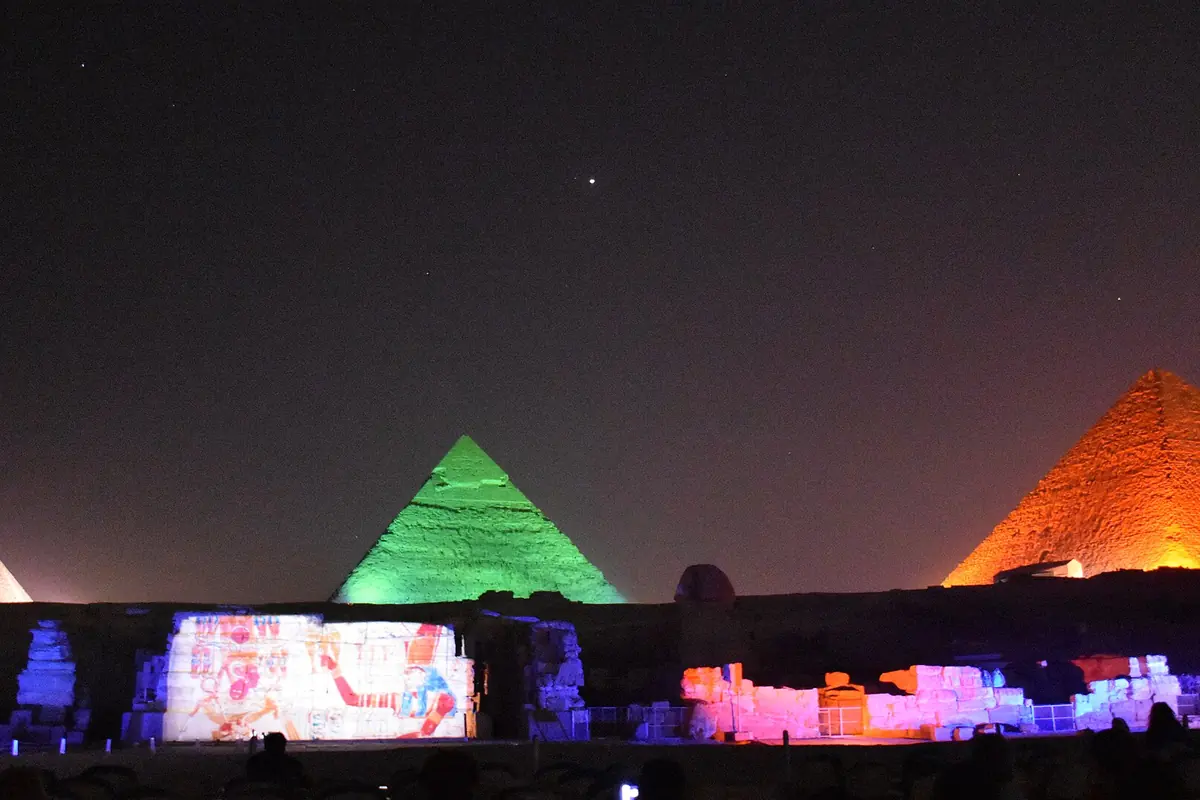
The phrase is French, and so is the idea. Wikipedia credits the concept to Paul Robert-Houdin, curator of the Château de Chambord in the Loire valley, and dates the world's first son et lumière to 1952 at that château. The form has a simple recipe. Take a historic building or monument, floodlight it with changing colours, add recorded narration and music, and tell the site's story to an audience seated in the dark. Wikipedia describes it as a form of nighttime entertainment usually presented in an outdoor venue of historic significance.
Why a historic site is the stage
The format works because the stage is already there. A château, a temple or a pyramid needs no scenery, and light can make stone look different from minute to minute. Colour can emphasise a corner, a facade or a whole silhouette, while the narration supplies the history that the building cannot speak for itself. The audience sits still, watches and listens. That is also why the format is judged differently from theatre: there are no performers, only the site, the lighting and the recorded voice.
Giza in 1961
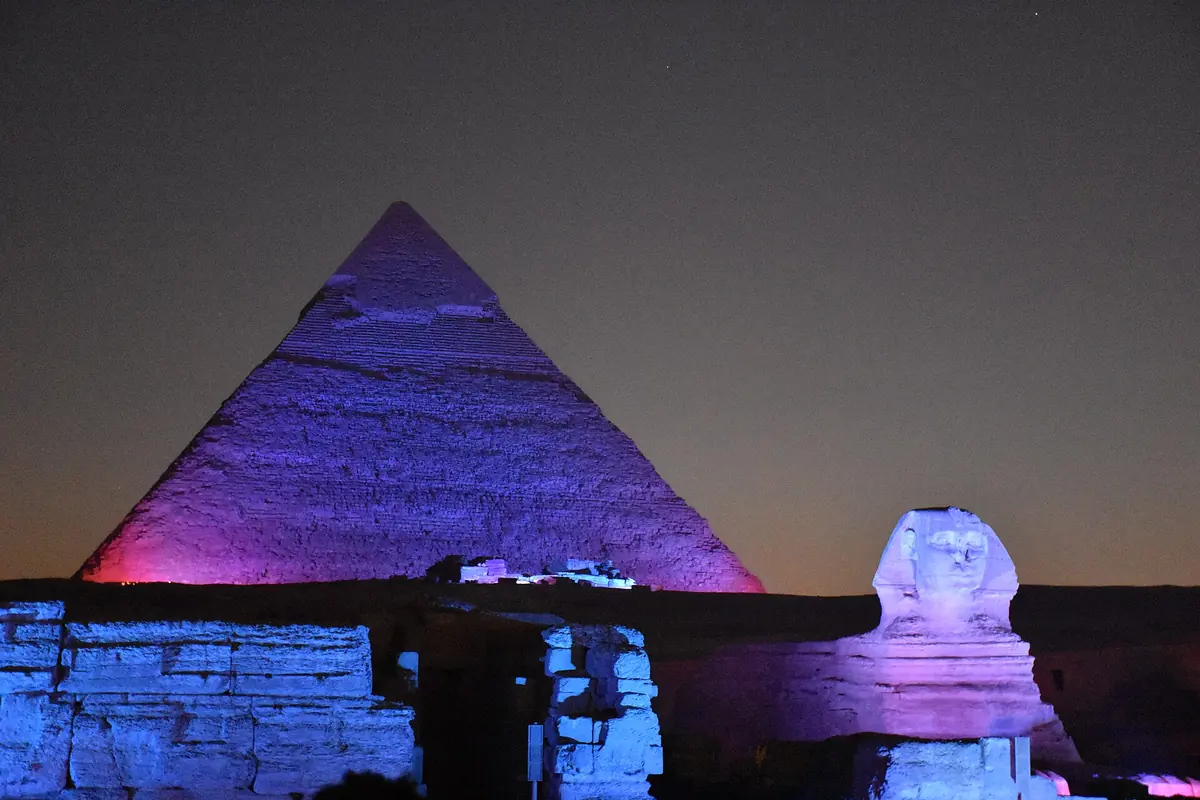
Wikipedia says the first African production of the form was staged at the Pyramids of Giza in 1961, less than a decade after Chambord. That makes the Giza show one of the oldest of its kind outside Europe, and it is the source for this site's line that a show has been staged at Giza since 1961. The date describes when the tradition began there. The sources used for this guide do not trace how the production has changed since, so it would be wrong to say tonight's show is the one that ran in 1961.
How the form works on the plateau
At Giza the colours fall on three pyramids, the Sphinx and the ruined temples around them. Photographs on Wikimedia Commons show the monuments lit in violet, pink, orange and green, a laser line crossing the sky and a painting projected on a wall between the pyramids. The audience sits in rows of chairs facing the monuments across open ground. The narration is recorded and plays in different languages on different nights, according to travel companies that sell the show.
What it is not
It is not a performance with actors, a concert or a dance show. That distinction explains much of the mixed reviews, because visitors who expect theatre are surprised. The Giza sound and light listings sat between 2.9 and 3.2 stars on a major booking site when checked, and the one this site covers scores 2.8. Reviewers who like the show praise the setting and the informative narration. Reviewers who do not call the production dated. Both groups are describing the same format.
How to use this knowledge
Knowing the form's history tells you what to expect: light, narration and a historic stage. It also helps you decide whether the evening suits you. If you enjoy atmospheric, slow, story-led experiences, a sound and light show can be a gentle and memorable evening. If you prefer fast, modern entertainment, the format will probably feel slow. Neither reaction is a mistake. The format simply asks for patience and a love of place.
Read next: Is the Giza sound and light show worth it, given its reviews?
Frequently asked questions
Who invented son et lumière?
Wikipedia credits Paul Robert-Houdin, curator of the Château de Chambord.
When did Giza get its show?
Wikipedia says the first African production was at the Pyramids of Giza in 1961.
Is the Giza show live?
No. It is coloured light with recorded narration and music.
Sources